
In April 2025, BNOS ran a Grant Workshop for Early Career Researchers in Neuro‑Oncology; an event made possible through dedicated sponsorship that enabled pump‑prime funding for two ECR‑led research projects. Both 6-month projects have now reached completion. We are pleased to present a summary of their outcomes and the progress achieved through this initiative.
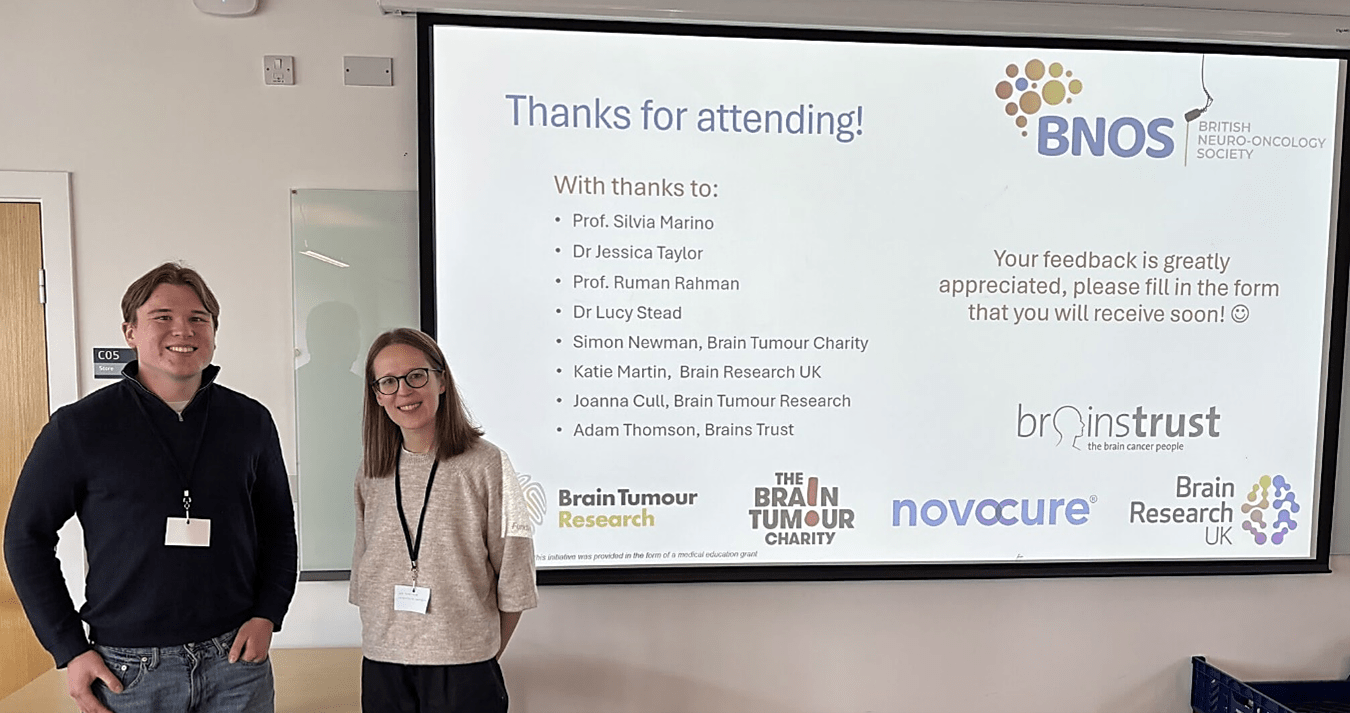
Josh Killelea (PhD Student, Imperial College London, pictured left) and Une Kontrimaite (PhD Student, University of Nottingham, pictured right) led a project titled Evaluating metabolic effects of electroactive drug delivery in a 3D glioblastoma co-culture model.
“This project aimed to evaluate the performance of a voltage-responsive electroactive drug delivery device using a biologically relevant, patient-derived 3D glioblastoma model that mimics key features of the in vivo tumour microenvironment. The electroactive device was applied to 3D glioblastoma spheroids to assess its biological effects compared with passive drug release and conventional drug treatment. The key outcome was the identification of optimal stimulation conditions that enabled reproducible drug release from the electroactive device. Metabolic profiling demonstrated that drug delivered via the voltage-responsive device induced changes in cancer cell metabolism that were comparable to those observed with standard IC₅₀ drug treatment, indicating effective therapeutic delivery. In contrast, glioblastoma invasive margin cells exhibited a distinct metabolic response, highlighting regional tumour heterogeneity. Astrocytes showed minimal metabolic alterations, suggesting a lower impact on non-cancerous brain cells. Importantly, the unloaded electroactive device alone induced negligible metabolic changes, confirming its biocompatibility.
Overall, this study demonstrated the feasibility of electroactive, voltage-controlled drug delivery in clinically relevant glioblastoma models and established a foundation for future development of targeted, on-demand therapeutic strategies through interdisciplinary collaboration.”
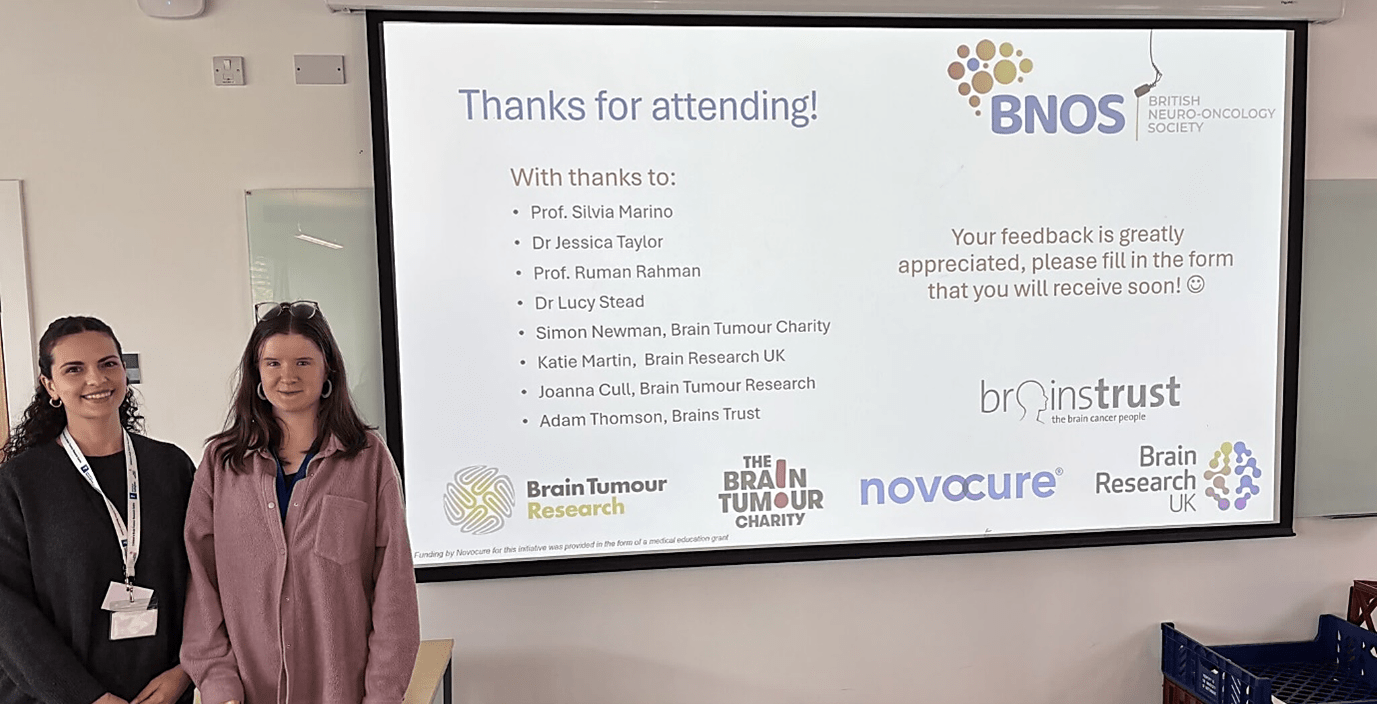
Dr Alina Pandele (Post-Doctoral Research Fellow, University of Nottingham, pictured left) and Sophie McCann (PhD Student, University of Nottingham, pictured right) led a project titled Exploring the role of hypoxia-driven extracellular vesicles in mediating neuron-tumour communication in paediatric brain tumours.
“In this project, we profiled hypoxia-associated extracellular vesicles (EV) protein signatures in two patient-derived paediatric brain tumour models, medulloblastoma and posterior fossa ependymoma. We cultured these cells at 21% or 1% O₂, isolated EV-enriched fractions by size exclusion chromatography and profiled EV output and protein cargo alongside matched cell lysates. EV concentration and modal diameter did not differ significantly between conditions, although both models trended towards increased EV release and smaller EVs under hypoxia. Qualitative EV proteomics identified oxygen-associated differences in detectable EV cargo, particularly in our ependymoma model (EPN11). Matched lysate proteomics showed a strong hypoxic metabolic shift in EPN11, with increased glycolysis/glucose metabolism and reduced mitochondrial pathways including fatty acid beta-oxidation and the TCA cycle, while our medulloblastoma line showed minimal change. Overall, this work is the first step towards defining how hypoxia alters EV secretion and cargo. The outputs are highly relevant for understanding hypoxia-driven pathways, with ongoing work looking at increasing EV yield to enable quantitative EV proteomics.”
Both teams plan to share their results at national conferences and are preparing manuscripts for submission to peer‑reviewed journals in the near future. They also intend to use these findings to support applications for further funding to advance their respective research programmes. BNOS extends its best wishes to both groups as they continue to advance their research initiatives following the workshop.